

The 7 Policy Areas Every Nonprofit Needs (And Why Most Only Have a Few)
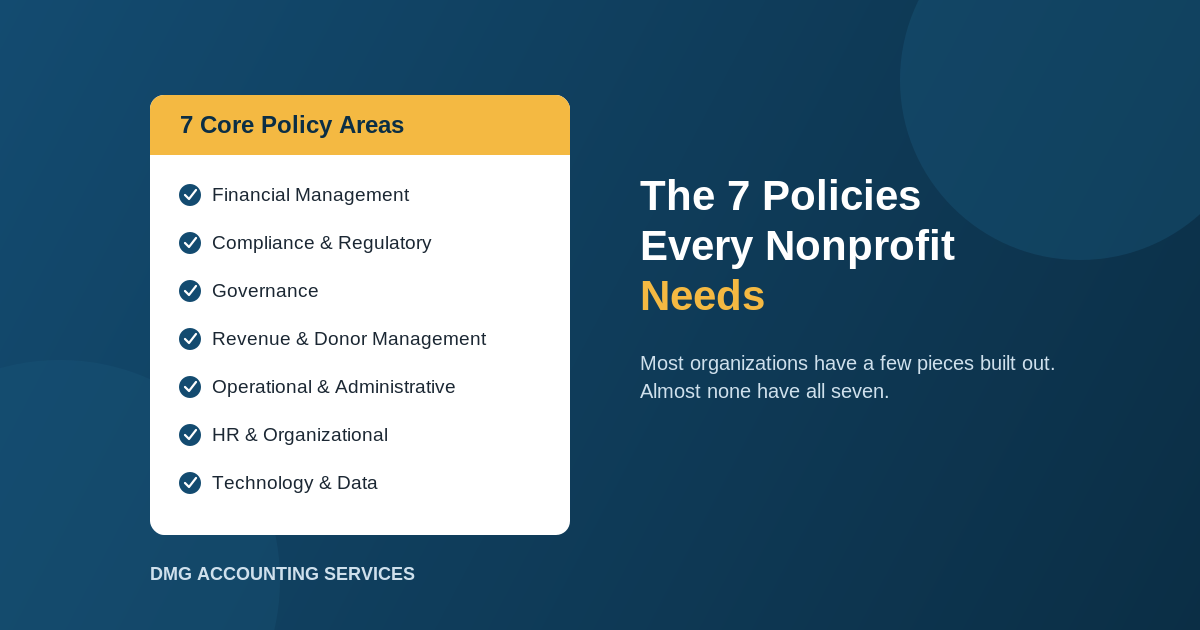
A recent post we shared on LinkedIn struck a nerve. We laid out the seven core policy areas every nonprofit should have in writing, and asked a simple question: which one is your organization strongest in, and which one needs the most work? The response told us this is a gap a lot of organizations are quietly worried about — so we wanted to unpack it further.
Written policies aren’t bureaucratic box-checking. They’re what protect your organization when a board member turns over, a grant auditor asks a hard question, or a well-meaning staffer isn’t sure how to handle a $5,000 check that just came in the mail. In our experience working with nonprofits, almost every organization has pieces of a few of these areas covered. Very few have all seven built out. Here’s what each one actually covers, and why it matters.
1. Financial Management
This is the operational backbone: accounts payable, procurement, cash handling, budgeting, and internal controls. Without documented procedures here, financial decisions end up in one person’s head — usually the bookkeeper or executive director — creating risk if that person leaves, gets sick, or makes a judgment call no one else agrees with.
2. Compliance & Regulatory
Conflict-of-interest, whistleblower-protection, and fraud-prevention policies aren’t just good practice — the IRS Form 990 specifically asks whether you have them. Beyond the paperwork, these policies provide staff and board members with a clear, safe process for raising concerns before small problems become front-page issues.
3. Governance
Board governance policies, finance committee charters, and executive compensation procedures define how your organization makes decisions. When these are undocumented, board transitions become messy and compensation decisions can look (or become) arbitrary — both of which invite scrutiny from funders and regulators alike.
4. Revenue & Donor Management
Gift acceptance policies, donor acknowledgment procedures, and revenue recognition practices protect both your organization and your donors. They answer questions such as: What types of gifts will we accept? How quickly do we issue a receipt? When does a multi-year pledge count as revenue? Neglecting this area is a common source of audit findings.
5. Operational & Administrative
Contract management and travel & expense policies keep day-to-day operations consistent and defensible. These are often the first policies organizations draft informally in an email thread — and the first to formalize, since they affect spending decisions made by many different people.
6. HR & Organizational
Employee handbooks, hiring practices, and organizational policies protect your staff and your organization equally. This area tends to get attention only when an incident forces the issue, rather than being addressed proactively — which is exactly backward.
7. Technology & Data
Data security, acceptable use, and technology policies are the newest additions to this list for most nonprofits, and the ones we see missing most often. As donor databases, cloud storage, and remote work have become standard, the absence of a data policy has shifted from a minor gap to a real liability.
Where to Start
You don’t need to build all seven areas at once. Start by identifying your weakest area — often the one that makes your board or ED most uncomfortable discussing — and build from there. A policy doesn’t need to be perfect to be useful; it needs to exist, be followed, and be reviewed periodically as your organization grows.
If you’re not sure where your organization stands across these seven areas, that’s a conversation worth having before your next audit or board meeting — not during it.
DMG Accounting Services works with nonprofits to assess and build out policies across all seven of these areas. If you’d like a second set of eyes on where your organization stands, reach out to us to schedule a policy review.